// ENGINEERING PORTFOLIO — REV 2026.08

MATT
GENTLEMAN

Mechanical Engineering student highly engaged in major robotics and satellite projects, well versed in optics, manufacturing, design, and implementation of mechanical systems.

Mechanical Engineering student fighting against Instagram reels to stay "locked-in" as the kids would say, my mom thinks I'm pretty smart, maybe you will too. I'm really good at Jeopardy, and opening glass bottles with random objects so long as they are rigid. Anyway, here's some cool stuff I've made.

[ VIEW PROJECTS ]

01 Personal Projects

PRJ-001

FLYWHEEL CAR - If you're not first, you're last
MECHANICAL DESIGN / GEAR TRAINS / ENERGY MANAGEMENT
Flywheel car
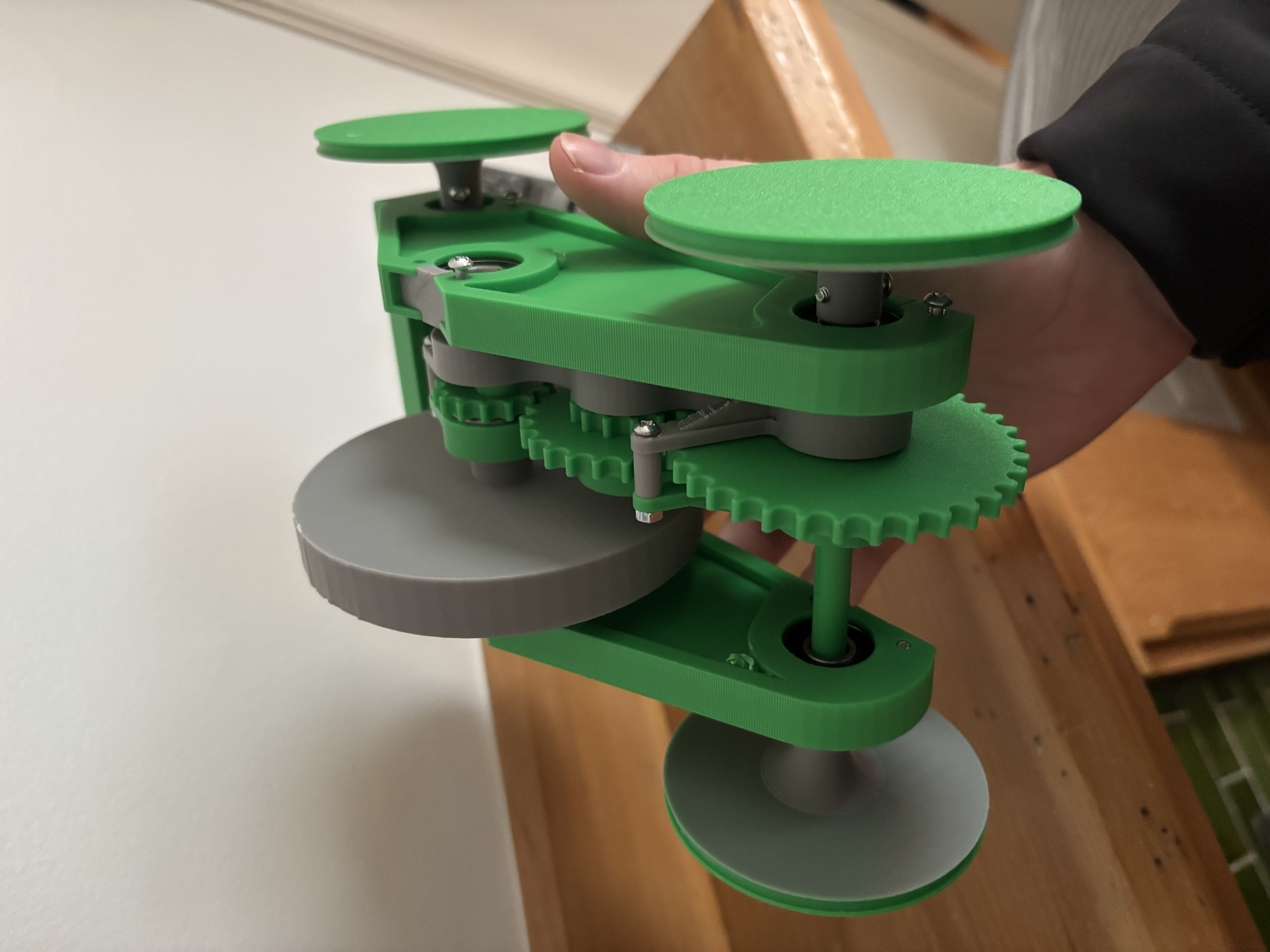
FIG. 1 — FLYWHEEL CAR

A design-class competition asked teams to build a car that would lose a race down a track. The caveat was that the car must only be propelled by gravity, and not come to a stop before the finish line. There were no timing devices allowed, and teams were not permitted to use any form of battery or logic boards.

Since the car's total energy was fixed by its starting height, the strategy was to store energy rather than dissipate it: shifting translational kinetic energy into rotational kinetic energy held in high-inertia rotating bodies. Moment of inertia was straightforward to maximize with large, disk-like wheels, but angular velocity — the dominant term, energy proportional to its square, is normally locked to the car's speed. The solution was a gear train driving a high-inertia flywheel at a large multiple of wheel speed, letting the car bank energy like a battery instead of bleeding energy off and risking total stoppage like most other solutions would.

Great competition premise: build a gravity-powered car that loses the race. Slowest car down the track wins — but it still has to cross the finish line. No timers, no microcontrollers, no cheating.

My thinking: ignoring friction, and all other things you are NOT supposed to ignore, the energy budget is effectively locked the moment the car sits at the top of the ramp. So instead of burning energy off with friction, why not stash it somewhere? Enter the heavy spinning body, or as industry pros like me call it: a flywheel. Angular kinetic energy scales with the square of spin speed, so I MacGyvered up a big chunky puck-like thing to spin far faster than the wheels using a gear train I designed on TinkerCAD of all places. The car siphons its own speed into a spinning battery and crawls across the line in last and not so fast.
PRJ-002

TELESCOPE PHONE MOUNT

3D PRINTING / CAD / ASTROPHOTOGRAPHY
FIG. 2 — IMAGE PENDING

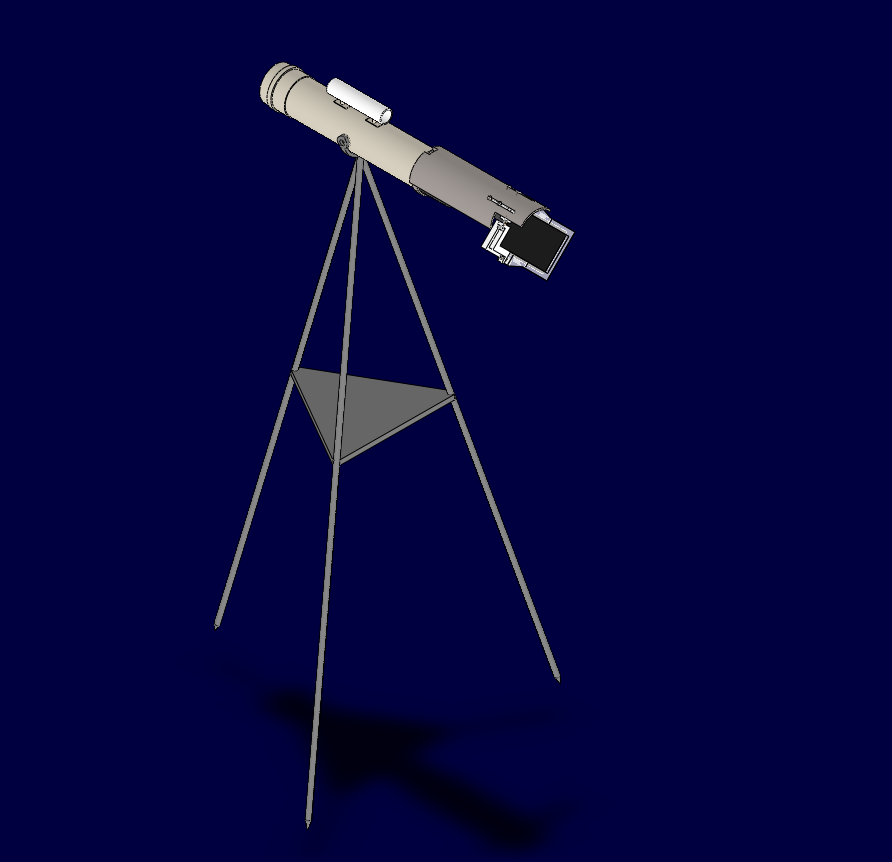
A 3D-printed smartphone mount for a telescope, designed to enable long-exposure astrophotography. For as long as I can remember I have been fascinated by the nighttime heavens and astrophysics, but was too nearsighted to get a proper view, but I realized that I could engineer this problem out of existence by creating a photography platform. As my first real project on an Ender 3, tolerancing and best 3D printing practice was learned through trial and error, a functioning product was the only thing that mattered, cleanliness and all other considerations were left aside. This was achieved by accounting for print shrinkage with a series of small test rigs before committing to full prints, with a 30 cm steel ruler as the only measuring instrument available.

A later revision added a sliding-plate mechanism so the camera could translate with the telescope's aperture as it extended and retracted for focusing. The finished mount produced functional, enlarged images of the night sky. Long exposures revealed star trails from Earth's rotation, roughly 15 arcminutes of drift over a 60-second exposure or about half the apparent width of the full Moon. This defined the obvious next step: a motorized tracking mount, shelved at the time for budget reasons.

I'm a complete astronomy and astrophysics nerd, but have this cruel dilemma where I cannot see stars very well. Until one day my uncle's telescope landed in my hands I immediately wanted to do nothing else but look up, and photograph everything so I could share this experience with others. First thing I ever made on my Ender 3, so every lesson arrived the fun way: shrinkage, tolerances, and the hard limits of measuring things with a 30 cm ruler. Many tiny test prints died so the final part could live, like mechanical Darwinism.

By the time I designed the phone cradle I'd leveled up enough that it fit perfectly on the first try (it helps that phone dimensions are public information). I was so excited to make the first version of the mount that I forgot the entire looking-piece moves as the aperture is adjusted for focusing and so version one had to go the way of the Dinosaur. Version two used a little sliding plate that could be tightened to its track by the four bolts that held it on there, a simple mechanism, but hey, whatever works, and it did. The exposures were beautiful, except every star had a tail: Earth's rotation drags them about 15 arcminutes across a 60-second exposure, half a full Moon's width. The fix is a motorized tracking mount, which was completely outside the budget of a little guy who'd just blown all his pocket change on a 3D printer.

PRJ-003

DRONE - we are not alone

AERODYNAMICS / SYSTEMS / NOVELTY
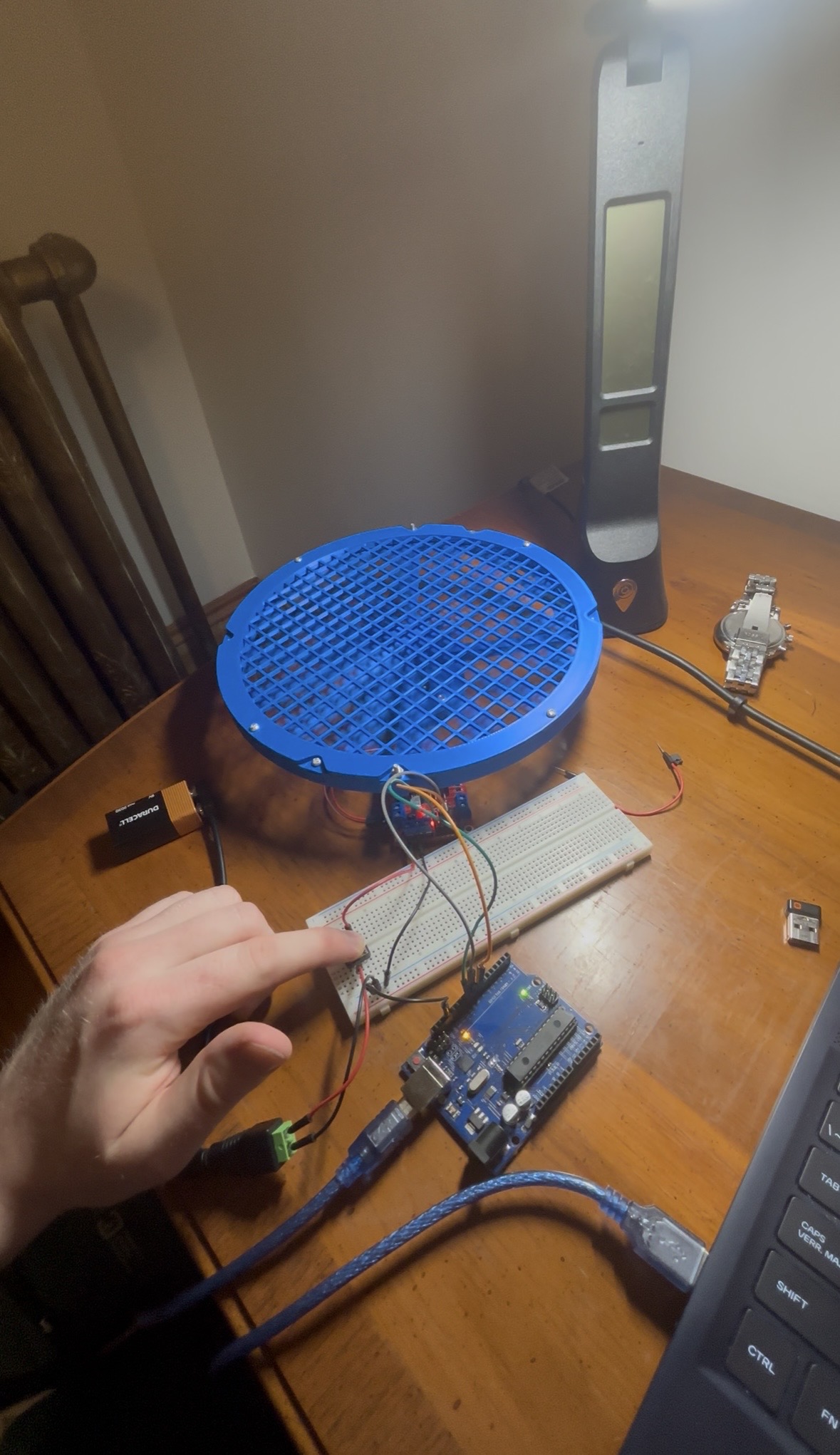
3D printed fan on desk
FIG. 3 — UFO PROTOTYPE

A custom drone build, currently in progress. The build of this drone as I plan it will be highly unconventional and likely will be a terrible design for a drone, but that is by design. I figure that no drone prototype I produce by myself will ever be remotely close to the capability of a production drone, simply because I think that's unrealistic for a lone maker in his bedroom. So, the real merit of this project is for me to learn about systems, Aerodynamics, Controls, design, etc. That is partially why I decided to not make a run-of-the-mill quadcopter build that I would in some capacity be a copycat of someone else's work regardless if I wanted to or not. This drone is explicitly going to be a mono-prop designed to emulate the classic flying saucer silhouette as closely as possible. More details to come.

Currently a figment of my imagination. This guy is explicitly designed to look funny for the stated purpose of being different, so I can't watch a 3 hour long step-by-step YouTube video on how to build a boring quadcopter. This guy is literally titled as "UFO" in my folders so you should not be surprised when I say that it'll be in the classic Roswell New Mexico flying saucer likeness. I'm probably going to have a PID that controls some counterweights to tilt it so it can like steer and stuff.

PRJ-004

SALMON SLIDER - weird Tetris thing

An original video game project where users play as a Salmon traveling up a treacherous stream to reach a spawning ground that is always too far away. Designed in MATLAB around similar architecture as Tetris this game randomly generated one of three objects at the top of the screen that translate down towards the player who can with a joystick either choose to jump or translate from left to right to avoid the obstacles. Developing this project challenged my coding skills and made me think about how to make the game run most efficiently, as well as test for bugs, flawed game mechanics, and other issues. In the end the mechanics of the game felt good, there was a score count that would record a highscore, the obstacles would spawn and despawn off screen, and would increase in speed logarithmically proportional to the number of communication event.

Yes, it's a video game about a sliding salmon. No, I will not be elaborating until the write-up is done.

PRJ-005

CLUB TREBUCHET

A trebuchet designed and built with the engineering club. Details coming soon.

The engineering club built a trebuchet. Objects were launched. Lessons were learned. Details soon.

PRJ-006

COAT HANGER

A practical design and fabrication project. Write-up coming soon.

Sometimes engineering is just needing somewhere to hang your coat. More soon.

02 Contact

I'm always open to discussing engineering opportunities and interesting problems.

If any of this made you smile (or raise an eyebrow), let's talk.

Matt.Gentleman@dal.ca